Present Simple vs Present Continuous
English gives you no neutral present tense. Every time you talk about now you have to decide whether you mean this is what happens or this is what is happening, and the ending on the verb commits you either way. Most sentences settle themselves with one question: is this true generally, or is it true now?
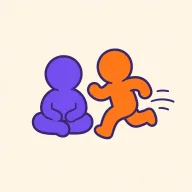
GENERALLY TRUEpresent simple
Monday to Friday, every one of them.
Nam usually walks to school.
True last week, true this week, true next week.
TRUE NOWpresent continuous
Yesterday no, today yes, tomorrow probably not.
But today he is taking the bus.
Today only, and true as we speak.
Both halves of that pair live in one ordinary sentence, because the natural way to describe an exception is to put it next to the rule. Many languages let a speaker leave the choice open and let context sort it out; English builds the choice into the grammar, so you make it every time you open your mouth.
TRY IT
- Question 1
"I to the gym every Saturday."
- Question 2
"Look! The children outside."
The two forms, and their two auxiliaries
PRESENT SIMPLE
SV (+ -s)
She works from home.
That is the arrangement, indefinitely.
PRESENT CONTINUOUS
Sam / is / areV-ing
She is working from home this week.
This week only — next week she is back in the office.
THE AUXILIARY
do / doesoram / is / are
Does she work here? · Is she working today?
Each tense keeps its own; borrowing the other one breaks the sentence.
The present simple builds negatives and questions with do / does, the continuous with be. Mixing them gives Do you working? and Are you work? — sentences whose meaning is clear and whose form is broken. Decide the tense, and the auxiliary is decided with it.
TRY IT
- Question 1
"Water at 100°C."
- Question 2
"Be quiet — the baby ."
- Question 3
" you working this weekend?"
When each tense is the right one
Routines and facts
He drinks tea every morning.
A pattern that repeats, or something always true. No edges: it was true before now and will be after.
Signal words: always · usually · every day · on Mondays · never
Happening as you speak
Listen! Someone is knocking.
One action in progress. You could point at it through the window.
Signal words: now · right now · at the moment · Look! · Listen!
Permanent situations
My sister works for a bank.
Her job, true whether or not she is at her desk this second.
Signal words: a job · a home · an ability · no end in sight
Today's exception
But today he is taking the bus.
One day out of the ordinary — which is why today and this week keep turning up beside it.
Signal words: today · this week · but today
Two tenses, one table
| PRESENT SIMPLE | PRESENT CONTINUOUS | |
|---|---|---|
| When | Habits and facts | Happening as you speak |
| Signals | every day · usually · always · never | now · at the moment · Look! · Listen! |
| Negative | don't / doesn't + verb | am / is / are not + verb-ing |
| Question | Do / Does + S + verb? | Am / Is / Are + S + verb-ing? |
| Example | I work every day. | I am working now. |
like, love, want, need, know and have in the sense of owning. They name something that simply is the case rather than something anyone is doing, which is why I am wanting and I am knowing are sentences a native speaker would rewrite. Have lunch and have a shower are actions, so I'm having lunch is perfectly normal.
TRY IT
- Question 1
"I a new phone."
- Question 2
"Can I call you back? I lunch."
Common mistakes
Incorrect:I am wanting a new phone.
Correct:I want a new phone.
Want is a state verb, so it stays in the present simple even about this moment.
Incorrect:Look! The children plays outside.
Correct:Look! The children are playing outside.
Look! points at this moment, so the sentence needs the continuous — and children is plural.
Incorrect:I am going to the gym every Saturday.
Correct:I go to the gym every Saturday.
Every Saturday is a routine, and routines belong to the present simple.
Incorrect:Do you working this weekend?
Correct:Are you working this weekend?
Each tense keeps its own auxiliary: do and does for the simple, be for the continuous.
Incorrect:She is having a new car.
Correct:She has a new car.
Have meaning own is a state; only the have that means eat, take or experience is continuous.
Incorrect:He is speaking English, French and Spanish.
Correct:He speaks English, French and Spanish.
A permanent ability takes the simple; the continuous would mean he is using all three now.
Incorrect:This soup is tasting delicious.
Correct:This soup tastes delicious.
Taste describing a quality is a state. Only somebody tasting the soup is an action.
Quick check · 6 questions
Choose the right pair of tenses:
Nam usually walks … is taking to school, but today he ___ the bus.
- A. walks … is taking — Correct
- B. is walking … takes
- C. walks … takes
Answer: A. walks … is taking
Usually marks a habit and today marks the departure from it. Putting the exception next to the rule is the most natural way English tells you both at once.
Choose the right tense:
Where is Lan? — She is cooking in the kitchen.
- A. is cooking — Correct
- B. cooks
- C. cook
Answer: A. is cooking
The asker wants to know where Lan is and what she is doing right now. "She cooks in the kitchen" would say that is where she usually cooks.
Choose the right tense:
Look at Nam! He is wearing a new shirt.
- A. is wearing — Correct
- B. wears
- C. wear
Answer: A. is wearing
Look!, Listen! and Be quiet! all announce that something is happening in front of you, and they pull the continuous with them.
Choose the word that starts the question:
Does your father work on Sundays?
- A. Does — Correct
- B. Is
- C. Are
Answer: A. Does
This asks about a habit, so it belongs to the present simple, and the present simple asks with do or does. Mixing the two gives you "Is your father work…".
Choose the right tense:
I like this song.
- A. like — Correct
- B. am liking
- C. likes
Answer: A. like
Like names something that is the case rather than something you are doing. Six verbs behave this way — like, love, want, need, know and have meaning to own.
Choose the right tense:
I am studying English now.
- A. am studying — Correct
- B. study
- C. studying
Answer: A. am studying
Many languages let context carry this and leave the verb alone. English builds the choice into the grammar, so a word like now settles it: the tense has to be the continuous.