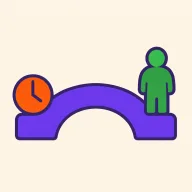
What the Present Perfect Is
The present perfect talks about something that happened, but it does not say when. What matters is whether it happened, or its result now.
The past participle is the third form of a verb, after the base form and the past simple: go – went – gone.
EXPERIENCENo time given
We know it happened, not which day.
I have seen this film.
I know this film. The day does not matter.
RESULT NOWShe has no keys now
She has lost her keys.
The result is now: she can't open the door.
PAST SIMPLEA time is given
A clear time, and that time is over.
I saw it last Saturday.
Last Saturday is a finished time, so the verb changes to the past simple.
No time given → usually have / has + past participle. A finished time given → past simple. With yesterday, last week or in 2020, do not use the present perfect.
TRY IT
- Question 1
"My parents to Phú Quốc in 2022."
- Question 2
"Oh no, I coffee on my laptop!"
The three forms
POSITIVE
Shave / haspast participle
They have moved to a new flat.
I / you / we / they → have; he / she / it → has. Short forms: I've, she's.
NEGATIVE
Shaven't / hasn'tpast participle
He hasn't called me.
Not goes straight after have / has; the verb stays a past participle.
QUESTION
Have / HasSpast participle?
Has the film started? — Yes, it has. / No, it hasn't.
Have / has moves in front of the subject — no do, no did.
PAST PARTICIPLES
- workworked
- gogone
- seeseen
- eateaten
- dodone
- bebeen
regular verbs → same as the past simple, -ed · irregular verbs → learn the third form
has gone, not has went · have eaten, not have ate.
TRY IT
- Question 1
"My brother a new job — he starts on Monday."
- Question 2
"The kids have all the cake!"
- Question 3
" Nam finished his report?"
When to use it
Experiences
My mum has visited Japan twice.
Something done at some point in your life. You can say how many times, but not when.
Signal words: once · twice · three times
A result you can see now
He has cut his finger.
The action is over and the result is here now: his finger is bleeding.
Signal words: lost · broken · cut · finished
News
The price of petrol has gone up.
Give the news first. The details after it use the past simple.
Signal words: has gone up · has opened · has won
Is it done?
Have you washed your hands?
Asking whether something is done.
Signal words: Have you…? · Has he…?
She has been to Huế means she went and came back. She has gone to Huế means she went and is not back yet.
Present perfect vs. past simple
| PRESENT PERFECT | PAST SIMPLE | |
|---|---|---|
| What matters | Whether it happened, and how things are now | When it happened |
| Time words | No finished time | yesterday · last week · in 2020 · two days ago |
| Example | Lan has passed her driving test. | Lan passed her driving test on Monday. |
| Questions with when | Not used | When did they get married? |
A conversation often starts with the present perfect. The details then use the past simple: I've met Minh's wife. — Really? Where did you meet her?
TRY IT
- Question 1
"I Mr Hùng two days ago."
- Question 2
" you lock the door when you left?"
Common mistakes
Incorrect:I have visited my grandma last weekend.
Correct:I visited my grandma last weekend.
Last weekend is a finished time, so the sentence needs the past simple.
Incorrect:She has went to work.
Correct:She has gone to work.
Has is followed by the past participle, not the past simple: go – went – gone.
Incorrect:He have finished the report.
Correct:He has finished the report.
He, she, it and singular nouns take has, not have.
Incorrect:Has she wrote to you?
Correct:Has she written to you?
Questions need the past participle too: write – wrote – written.
Incorrect:When have you arrived?
Correct:When did you arrive?
When asks about a finished moment, so the question takes the past simple.
Incorrect:My sister has been to Hà Nội. She's coming back next week.
Correct:My sister has gone to Hà Nội. She's coming back next week.
Somebody who went and has not come back has gone; has been means they are back.
Quick check · 8 questions
Choose the correct tense:
Khoa broke his arm last Friday.
- A. broke — Correct
- B. has broken
- C. has broke
Answer: A. broke
Last Friday says exactly when it happened, so the sentence needs the past simple. The present perfect does not go with a finished time like that.
Choose the correct auxiliary:
Our teacher has given us a lot of homework.
- A. has — Correct
- B. have
- C. is
Answer: A. has
Have is for I, you, we, they and plural nouns. One person, like our teacher, takes has.
Choose the correct verb form:
I've done the dishes, so you can relax.
- A. done — Correct
- B. did
- C. do
Answer: A. done
Do – did – done: after have or has you need the third form, done. Did is the past simple form.
Choose the correct verb form:
They have painted the living room blue.
- A. painted — Correct
- B. paint
- C. painting
Answer: A. painted
Paint is a regular verb, so its past participle is the same as its past simple: painted.
Choose the correct negative:
Linh hasn't answered my message.
- A. hasn't — Correct
- B. haven't
- C. not has
Answer: A. hasn't
Linh is one person, so the auxiliary is has, and not comes straight after it: has not, or hasn't.
Choose the correct question:
Have you fed the cat?
- A. Have you fed the cat? — Correct
- B. You have fed the cat?
- C. Have you feed the cat?
Answer: A. Have you fed the cat?
A present perfect question puts have or has first, with no do or did. The main verb stays in the past participle: fed.
Dad is not at home. Choose the correct sentence:
Dad isn't here right now. He has gone to the post office, but he'll be back soon.
- A. has gone — Correct
- B. has been
Answer: A. has gone
Has gone means he went and is not back yet. Has been means he went and came back, which does not fit "he'll be back soon".
Choose the correct auxiliary:
When did you buy that jacket?
- A. did — Correct
- B. have
- C. has
Answer: A. did
When asks about a finished time, so the question uses did and the past simple.
See whether it really stuck.
Start the quiz · 12 questions