What Much, Many and A Lot Of Mean
English has no single word for a large amount. It has three, and the one you need depends on two things: what kind of noun follows, and what kind of sentence you are in.
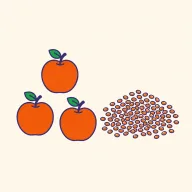
COUNTABLE → MANYthings you count
Counted one by one: one, two, three, four.
There are many people at the market.
People come one by one, so the word is many.
UNCOUNTABLE → MUCHthings you measure
One quantity, measured rather than counted.
I don't have much time.
Time is measured rather than counted, so the word is much.
So this lesson rests on the previous one. If you are not sure whether a noun is countable, put two in front of it: two friends works, two waters does not mean what you think it means.
TRY IT
- Question 1
"There isn't water in the bottle."
- Question 2
" students are absent today."
Which word goes where
MANY
manycountable plural
many books · many people · many days
Things you can count one by one.
MUCH
muchuncountable
much water · much money · much time
Things you measure rather than count.
A LOT OF
a lot ofeither kind
a lot of books · a lot of water
Works with both — the safe choice when you hesitate.
The of is not optional in front of a noun — a lot of money, never a lot money. Drop the noun and you drop the of with it: I eat a lot. · Thanks a lot.
A lot of people are waiting outside. — people is plural. A lot of water is wasted every day. — water is uncountable, so singular. The words a lot of never decide the verb; whatever follows of does.
TRY IT
- Question 1
" waiting outside."
- Question 2
"I don't have money this month."
- Question 3
"He has in Hà Nội."
When to use each one
Asking about countable things
How many students are there?
A countable plural follows, and the answer is a number: twenty-five.
Signal words: How many · countable plural · a number
Asking about uncountable things
How much water do you drink?
An uncountable noun follows, and the answer is an amount: about two litres.
Signal words: How much · uncountable · an amount
Asking a price
How much is this shirt?
No noun at all. Learn it whole — it never becomes How many, even for three shirts.
Signal words: How much is it? · How much are they? · shops · markets
After too, so, as and how
There is too much salt in the soup.
These small words rescue much completely, even in a positive sentence.
Signal words: too much · too many · how much
Much, many and how much
| COUNTABLE | UNCOUNTABLE | |
|---|---|---|
| How many / how much | How many friends? | How much money? |
| In a negative | I don't have many friends. | I don't have much money. |
| In a statement | I have a lot of friends. | I have a lot of money. |
| Asking a price | — | How much is it? — no noun at all |
Keep much and many for negatives and questions: I don't have much time, How many books? The exception is the fixed pairs — too much, too many — where much sits happily in a statement.
TRY IT
- Question 1
"I have money this month."
- Question 2
" is this bag?"
Common mistakes
Incorrect:I have much money.
Correct:I have a lot of money.
Much is avoided in plain positive statements; a lot of is what people actually say.
Incorrect:She has much friends in Hà Nội.
Correct:She has a lot of friends in Hà Nội.
Friends is countable, so much is impossible — and a positive sentence wants a lot of.
Incorrect:How many money do you have?
Correct:How much money do you have?
Money is uncountable, so the question word is How much.
Incorrect:There are a lot of informations online.
Correct:There is a lot of information online.
Information is uncountable: no -s, and the verb goes singular with it.
Incorrect:I don't have a lot money.
Correct:I don't have a lot of money.
In front of a noun, a lot always keeps its of. Only without a noun can it stand alone.
Incorrect:Too many sugar is bad for you.
Correct:Too much sugar is bad for you.
Too does not change the choice: sugar is uncountable, so it is too much.
Quick check · 6 questions
Choose the right word:
There aren't many chairs in this room.
- A. many — Correct
- B. much
- C. a lot
Answer: A. many
If you are unsure whether a noun is countable, put two in front of it. "Two chairs" is normal English, so the noun is countable and takes many.
Choose the right word:
I don't drink much coffee.
- A. much — Correct
- B. many
- C. a lot
Answer: A. much
"Two coffees" only works when you are ordering cups. Spoken of as a drink, coffee is uncountable, and in a negative it takes much.
Choose the right phrase:
My city has a lot of parks.
- A. a lot of — Correct
- B. much
- C. a lot
Answer: A. a lot of
A lot of works with both kinds of noun. And the of cannot be dropped while a noun follows: "a lot parks" is not English.
Choose the right question words:
How many brothers do you have?
- A. How many — Correct
- B. How much
Answer: A. How many
How many goes with a plural noun, how much with an uncountable one.
You are asking the price of a shirt. Choose the right question:
How much is this T-shirt?
- A. How much is — Correct
- B. How many is
- C. How much are
Answer: A. How much is
There is no noun after "How much is…?" at all, and it never turns into How many, even when you are pointing at three shirts. One shirt takes is.
Choose the right phrase:
We have a lot of homework today.
- A. a lot of — Correct
- B. a lot
- C. many
Answer: A. a lot of
You drop the of only when the noun goes too: "I eat a lot." And homework is uncountable, so many is out.
See whether it really stuck.
Start the quiz · 14 questions