What Object Pronouns Are
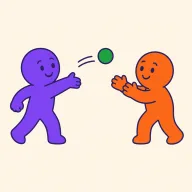
An object pronoun is the form a pronoun takes when it receives the action instead of performing it: me, you, him, her, it, us, them. The same person, standing at the other end of the sentence, is a different word.
AFTER A VERBThe one being called
The same person: she as the subject, her as the object.
Nam calls her.
Nam gọi điện cho cô ấy.
AFTER A PREPOSITIONWho you are going with
After the preposition with, we has to become us.
Come with us.
Đi với bọn mình nhé.
Many languages, Vietnamese among them, use one word in both places and let the word order do the work: Tôi thích anh ấy and Anh ấy thích tôi keep both words unchanged. Because your first language has no such step, the reflex when speaking fast is to leave I, he and she where they are — which is the mistake this lesson is here to head off.
TRY IT
- Question 1
"I know very well."
- Question 2
"Wait for , please."
The three patterns
AFTER A VERB
SVobject
I know him well.
Exactly where a name would go: I know Nam.
AFTER A PREPOSITION
Vprepositionobject
Wait for me!
with, for, to, at, about, between — all of them take this form.
THE CHANGE AT A GLANCE
- Ime
- hehim
- sheher
- weus
- theythem
you and it do not change · one set of words covers both positions
Only five pronouns really change shape. You and it look the same wherever they stand — which is convenient, and also the reason they never warn you when the rest of your sentence has gone wrong.
TRY IT
- Question 1
"Please help with these boxes."
- Question 2
"This present is for ."
- Question 3
"Please call tonight."
When to use them
After a verb
I know him yesterday.
The person or thing on the receiving end.
Signal words: see · help · call · know · like
After a preposition
Wait for me!
After every preposition, with no exceptions.
Signal words: with me · for us · to him · about them
You and it never change
I like this song. Do you like it?
These two keep one shape in both slots, which is why they never warn you that a sentence is wrong.
Signal words: you · it
After be, in a short answer
Who's there? — It's me.
Everyday English uses the object form after be.
Signal words: It's me · That's him
That last card is where some books go the wrong way. After be, the natural sentence is It's me, That's him at the door. The strictly logical It is I is now so formal that it sounds like a joke — say It's me.
Subject pronouns vs. object pronouns
| SUBJECT | OBJECT | |
|---|---|---|
| the speaker | I know Nam. | Nam knows me. |
| the listener | You know Nam. | Nam knows you. |
| one man | He knows Nam. | Nam knows him. |
| one woman | She knows Nam. | Nam knows her. |
| a thing or animal | It costs a lot. | Nam wants it. |
| the speaker's group | We know Nam. | Nam knows us. |
| other people or things | They know Nam. | Nam knows them. |
The trouble starts when a pronoun shares the slot with somebody else. There is a test that takes one second: take the other person out. I share a room survives → My sister and I share a room. A photo of me survives → a photo of my brother and me.
Two things are worth saying honestly. First, Me and my sister go to the cinema every Friday is what a great many English speakers say every day; that is ordinary spoken English, not an error — but in writing, in an exam or in a job application, the expected form is My sister and I. Second, the fear of getting it wrong pushes people the other way, into between you and I, which puts a subject pronoun after a preposition. That one is wrong in speech and in writing alike. The careful form is between you and me.
TRY IT
- Question 1
" play football every Saturday." (written in an essay)
- Question 2
"This is a photo of my brother and ."
Common mistakes
Incorrect:I know she very well.
Correct:I know her very well.
The person seen is the object of the verb, so the object form is needed.
Incorrect:Come with we.
Correct:Come with us.
With is a preposition, and a preposition is always followed by an object pronoun.
Incorrect:Give it to he.
Correct:Give it to him.
Both pronouns are objects here — one is the thing given, the other the person it goes to.
Incorrect:Between you and I, the food is terrible.
Correct:Between you and me, the food is terrible.
Between is a preposition; adding 'you and' in front does not make I right.
Incorrect:Me like coffee.
Correct:I like coffee.
The person doing the liking is the subject, and the subject form of me is I.
Incorrect:These are my keys. I can't find it.
Correct:These are my keys. I can't find them.
Keys is plural, so the pronoun is them; it can only replace one single thing.
Quick check · 6 questions
Choose the right pronoun:
I don't know her very well.
- A. her — Correct
- B. she
- C. hers
Answer: A. her
She is receiving the action rather than doing it, so the form is her. Hers stands alone and cannot take a place in the middle of a sentence like this.
Choose the right pronoun:
This gift is from us.
- A. us — Correct
- B. we
- C. our
Answer: A. us
From is a preposition, and every preposition is followed by an object pronoun. There is no exception to that anywhere in English.
Choose the right pronoun:
I and my sister like music.
- A. I — Correct
- B. Me
- C. My
Answer: A. I
Take the other person out of the sentence and the answer is obvious: "I like music". In speech you will hear "Me and my sister", which is ordinary spoken English — but the written form is "My sister and I".
Choose the right pronoun:
Nam has a sister. He loves her very much.
- A. her — Correct
- B. him
- C. she
Answer: A. her
The sister is the one being loved, so the pronoun is her. Him would be the object form of Nam, who is the one doing the loving.
Choose the right pronoun:
These are my glasses. I can't find them.
- A. them — Correct
- B. it
- C. they
Answer: A. them
It stands in for exactly one thing. Glasses is plural, so the pronoun that replaces it is them.
Choose the right pronoun:
I like this song. Do you like it?
- A. it — Correct
- B. them
- C. its
Answer: A. it
It keeps the same shape in both slots, subject and object. Convenient — and it is also why these two words never warn you that a sentence has gone wrong.